What Should Manifold Gauges Read for Ac on Car
Tools Needed:
- An air conditioning manifold judge ready
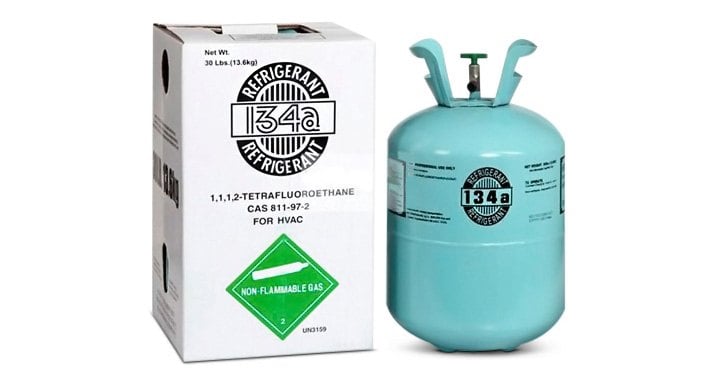
- A supply of R-134a refrigerant if needed for recharging (bachelor locally)
- Open ended wrench prepare
An air conditioning manifold approximate set is a must-have tool for anyone who is interested in performing some basic system work at home, such as checking pressure in a/c lines, determining if there's a leak, calculation small amounts of refrigerant, or performing a consummate evacuation and recharge. Compact, hand-held manifold gauge sets are used universally when servicing domicile air conditioning systems likewise as automotive ones, and professional technicians use them same way you tin in your back yard. Although shops typically have big, costly machines that do the evacuating and recharging work, like results can be accomplished with equipment that tin can exist purchased inexpensively and stored easily.
Considering air conditioning hoses and o-rings are fabricated of rubber, it is common for some of the a/c refrigerant to work its way out of the organization over a period of several years. An a/c manifold gauge will allow you to give your organization a recharge each yr – keeping your vehicle cool while saving you lot a great deal of money over the vehicle's lifetime. A manifold gauge set will also let you decide if your system is fully charged or not, or if your arrangement is losing pressure level at a rate that indicates there is a large leak. Even if yous won't be servicing the system yourself, it will help you determine whether you need repairs or merely a recharge.
One of the important basics to know before using an a/c manifold guess ready is the blazon of refrigerant that your vehicle has. For reference, refrigerant type R-12 (also known as automotive refrigerant) was used from the earliest days of automotive a/c systems until the U.S. government outlawed it later the 1993 model twelvemonth considering of its harmful outcome on the Earth's ozone layer. While some vehicles made a switch to newer R-134a refrigerant before they were required to, any 1994 model twelvemonth vehicle sold in the United states was designed to operate on R-134a.
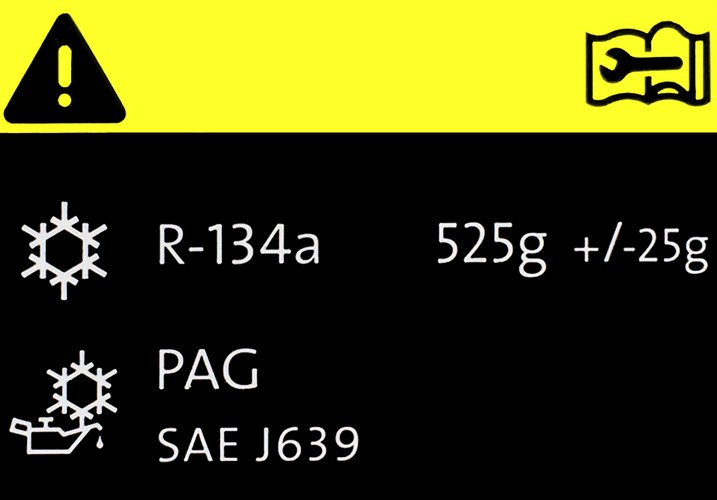
A sticker mounted in the engine compartment or on the underside of the hood will provide the refrigerant type, but if it'south missing you'll also find the information in the owner's manual or past calling the vehicle manufacturer. If an older vehicle has been converted to R-134a, a new sticker stating so should be affixed in identify of the original one. R-12 and R-134a employ dissimilar size fittings in order to avoid mixing the two types of refrigerant.
Because R-12 is no longer manufactured and has not been used in cars for over 20 years, this article will focus on systems designed for R-134a. Universal manifold sets with fittings for both refrigerants are available, should yous have an older vehicle or be unable to decide what kind of refrigerant is in your motorcar or truck.
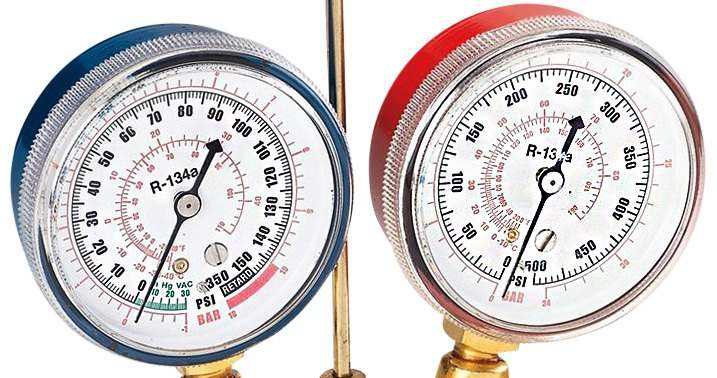
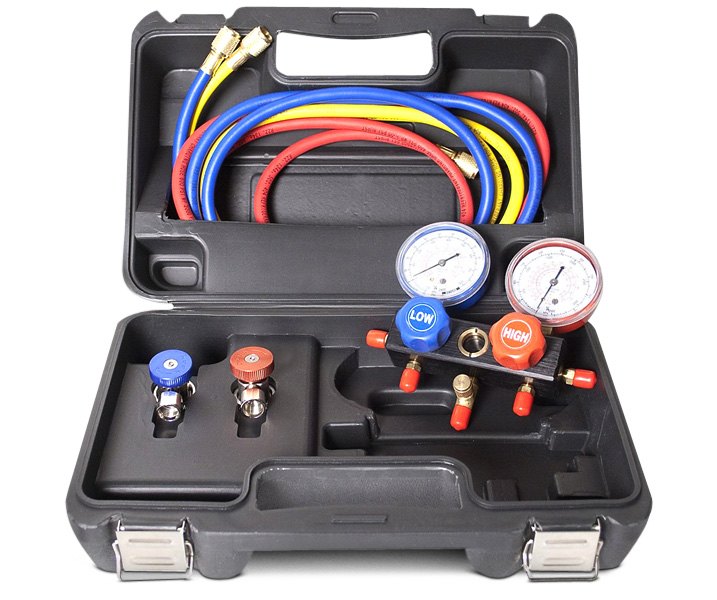
Looking at any a/c manifold gauge, you'll see a blue-colored pressure dial and hose on the left side, a reddish-colored pressure dial and hose on the correct, and a xanthous hose in the middle with no corresponding dial. Blueish represents the depression pressure side of the air conditioning system, and red represents the high pressure side. The low-side judge is also known as a compound gauge because information technology tin also provide a reading for vacuum (expressed in "inches of mercury") when performing an evacuation. The yellowish hose in the center is designed for refilling the a/c system with canned refrigerant during recharging, and it tin can also be used for evacuating the system with a vacuum pump.
Hoses on a/c manifold sets hands connect and disconnect to fittings on the vehicle with Schrader way valve couplings. Some hoses are designed with "manual" couplers that feature a quick release button on top which must exist depressed manually to lock the connection in place, and other hoses are designed with "automatic" couplers which click into place with a simple push. Instead of using a pushbutton to release, a lock ring is moved by hand. Whichever style is used, it is important that the blueish hose is connected to the vehicle's low pressure side, and the blood-red hose is connected to the vehicle's high pressure side.
Testing The Performance Of Your A/C
As a recommended starting time footstep, a quick force per unit area examination of your vehicle'southward a/c system with it running will requite you an thought if operating pressures are inside specifications. Afterwards closing both low- and high-side valves on the manifold approximate fix, connect hoses to corresponding depression- and high-side pressure fittings on the vehicle. Start your engine and run the a/c system with all controls at their maximum setting until it has had time to absurd the inside of the automobile. (Make sure that your car or truck does non overheat. In some situations, you lot may need to put a fan in front end of the radiator to evangelize additional airflow.) Open the valves on the manifold set up, then cheque low and high pressures on the dials, comparing the readings to the normal range of the operating pressures specified in your possessor's manual or repair guide.
Excess high-side pressure can result from too much refrigerant in the system, a organization brake, air in the lines, or not enough airflow beyond the condenser (in front of the radiator). A likewise-low high-side pressure can mean refrigerant level is low or the compressor is malfunctioning. If the low-side pressure is higher than normal, doubtable refrigerant overcharge or a defective compressor. Lower depression-side force per unit area can hateful there is a restriction in the depression-side of the system, the refrigerant level is low, or in that location is non plenty airflow across the condenser.
Topping Up Your A/C System
If you have found that your a/c system gradually lost cooling ability over time, and a pressure cheque shows both low side and high side pressures to be slightly depression, you lot many only need to add together a pocket-sized amount of refrigerant. Service-sized cans of R-134a are available at about automobile parts stores and fifty-fifty some hardware stores. If there is a pocket-sized leak, you might be able to do an annual recharge, and you'll continue to enjoy cold air coming out of your vents provided there are no major leaks.
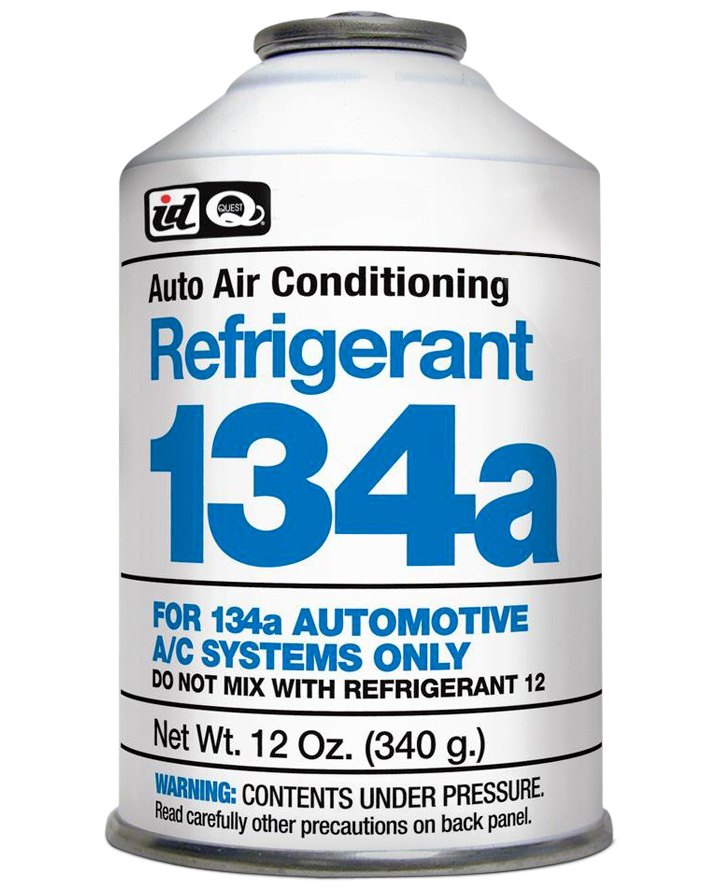
To recharge your a/c system, insert a valve in the tin of new refrigerant you'll be using (yous may need a wrench for this process depending on the valve design). Make sure the can and the valve knob are facing up to ensure y'all'll be drawing refrigerant vapor from the top of the can instead of liquid refrigerant from the bottom. The valve knob should also be in the closed position before installing information technology on the refrigerant container.
With the valve knob airtight on the refrigerant canister, connect the yellow hose from the a/c manifold gauge set. With the line connected, open the valve on the can. The next step in the process is to bleed air out of the yellow line so that information technology does non get pushed into the a/c system. Do this by loosening (but not disconnecting) the yellow hose plumbing fixtures at the summit of the manifold estimate set up until you hear air hiss out for two seconds.
With both depression- and high-side valves still closed, start the vehicle and turn on the a/c to max. Open only the low side valve on the manifold.
Caution! Opening the high side valve when the a/c compressor is running will damage the compressor.
Watch the gauges, adding refrigerant only until the vehicle manufacturer's specifications take been reached. To stop adding refrigerant, close the manifold depression-side valve. Turn the valve on the canister off.
Performing A Complete Evacuation And Recharge Of The A/C System
If your system is very low (or empty) on refrigerant, you should commencement diagnose and repair any big leaks in the organisation. Even if y'all do not have a leak, some professionals adopt a complete "evac & recharge" every bit the most authentic style of installing the exact amount of refrigerant required. Should you go this road, y'all'll need a compact electrical vacuum pump designed for automotive a/c systems. The process begins by twisting both depression- and high-side valves on the manifold gauge set to the closed position (both on the guess housing and at the hose ends), then connecting the hoses to corresponding low- and high-side force per unit area fittings on your vehicle. Once hoses are connected to vehicle fittings, open the valves where they attach to the vehicle.
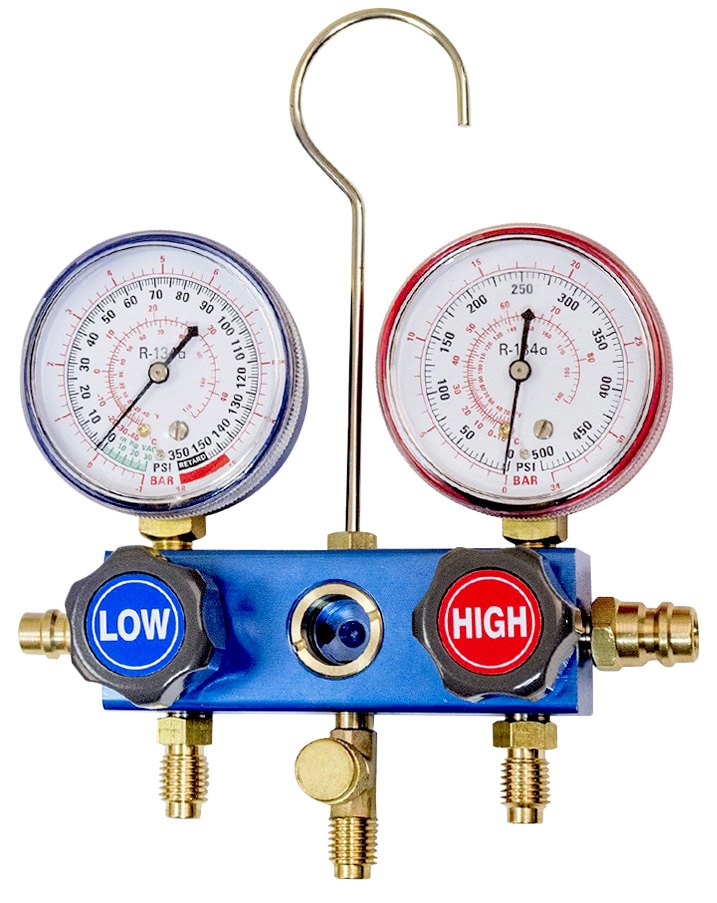
Simply the low-pressure side gauge has a reading for vacuum. When the system is beingness evacuated, the needle will travel to the other side of zero to reflect negative pressure (vacuum) in the lines as shown hither. If the system holds vacuum pressure without dropping for 30 minutes after being evacuated, there are no leaks in the system.
Next, connect the yellowish hose to your vacuum pump and turn it on. Once it'southward running, open the low and high-side valves on the manifold gauge housing. Allow the pump run for 30 to hour until y'all see the low-side punch displaying a vacuum reading of thirty inches of mercury. The high-side gauge needle will remain at cypher the entire time. Once proper vacuum has been reached, shut both high and low-side valves and close the pump off.
Now, spotter the low side gauge for another 30 minutes. If vacuum holds for 30 minutes after the pump is shut off, the arrangement does not have any leaks.
A decline in pressure ways in that location'southward a large leak somewhere or water in the system has boiled off. To decide which is the case, echo the evacuation process for 30 minutes with the pump, then let information technology sit again for another 30 minutes. If the pressure declines once again, at that place is withal a leak in the arrangement which needs repair.
At this point, the recharge is similar to the above, except you want to take on hand the exact amount of refrigerant specified by your vehicle'due south manufacturer. Typically that spec is given in pounds, although you may find information technology in grams on imported vehicles. If you are using, permit's say, a 30-lb. can of R134a, at that place are scales which volition give you the 'before' and 'later' weight, and then that yous know you've added the right amount. Once you've added the full accuse, check the pressures one more than time to ensure that are where they should exist. (The manifold gauge sets from CARiD come complete with specific user'due south instructions.)
If you discover that your ride's a/c system has a major leak and you are at present in need of replacement components, CARiD has high-quality replacement parts also as a/c hoses & o-rings, expansion valves, relays & switches, and other parts to keep your vehicle at OEM specifications and ensure things stay cool.
October 02, 2014
Source: https://www.carid.com/articles/how-to-use-an-air-conditioning-manifold-gauge-set.html
0 Response to "What Should Manifold Gauges Read for Ac on Car"
Post a Comment